
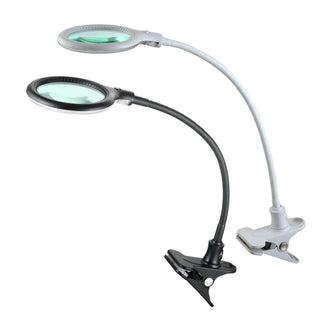
Anyone looking for an illuminated magnifier meets two very different designs: the standing magnifier with light that simply sits on the desk, and the magnifying lamp on an articulated arm that clamps to the table or sits on a stand. Both do the same job — they magnify and light at once. The difference is how they reach the work.
What a standing magnifier with light offers
A table magnifier brings its own base. Unpack it, put it down, plug it in — done. Nothing is clamped, nothing mounted, nothing fixed to the tabletop. That is its advantage wherever clamping is out of the question: glass tables, tops with a raised edge, furniture that must not be marked, and workstations that belong to someone else later in the day.
The price is reach. A standing magnifier stays where it stands. The workpiece comes to it, not the other way round. For work that happens in a small field anyway — inspecting, reading, examining, fine handwork in one spot — that is not a drawback but a reassuring constant.
Our Lambda S is built this way: a 100 mm glass lens with 3 dioptres, infinitely dimmable, weighing around 1.8 kg. The weight is deliberate — a light base wanders at every touch.
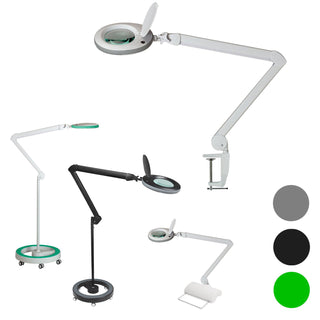
What the articulated arm offers
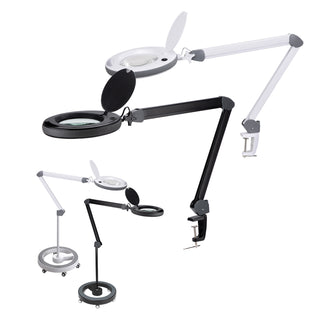
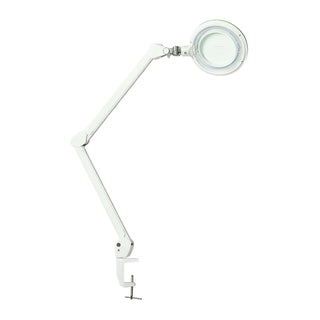
The arm lamp reverses the relationship: it comes to the workpiece. The arm swings across the surface, adjusts in height and moves aside when no magnification is needed. The desk stays clear, because the lamp sits at the edge or on a stand beside the table.
This design also carries the larger lenses. Where a standing magnifier stops at around 100 mm, a sprung arm can hold 127 mm, 152 mm or an oval lens — with a correspondingly wider field of view. If you work for hours in the same place and range across a larger area, that is noticeably more relaxed.
The middle way: a clamp lamp with a table base
There is a middle option that is often overlooked. Our 680X ships with both fittings: a table clamp and a table base. It can be clamped like an arm lamp or stood freely like a standing magnifier — and the choice can be reversed at any time. For workstations that are still changing, or if you simply would rather not commit, it is the lowest-risk option.
Five questions that make the decision for you
- Will your tabletop take a clamp? Glass, raised edges and delicate surfaces argue for the standing magnifier.
- Does the work range across the surface? Then you need the reach of an arm.
- How often does the location change? A standing magnifier moves in seconds; a clamped lamp does not.
- How wide should the field of view be? Beyond 100 mm of lens diameter, the path leads to an arm lamp.
- How much desk do you have? A base occupies space permanently, a clamp almost none.
What the design does not change
Whatever the design, the optical questions stay the same: the dioptre rating sets magnification and working distance, our lenses are real glass either way, and the light is daylight-white. Which strength you need is covered in dioptres and magnification. If you have settled on the arm, table clamp, stand or wall bracket takes it from there.

0 comments